Tuesday, June 5, 2012

Day 4/6
Day 4, Camille and I have video recorded a summery of what we had accomplished that day. However, we could not get it from her blog onto my blog.
Day 6, I tried everything to the video Camille and I recorded together to get it on my blog, still wouldn't work. I even tried recording another video with my computer's camera, but it would not go through and connect to the system.
Day 6, I tried everything to the video Camille and I recorded together to get it on my blog, still wouldn't work. I even tried recording another video with my computer's camera, but it would not go through and connect to the system.
Monday, June 4, 2012
Day 5 -- Last filming day and Editing day
Today, we filmed the last part of the Mind Altering Drugs objectives for chapter 15. Unfortunately, the plans to make this a funny video turned out to be a bust, because the technology that was needed, in this case it was Camile's laptop, and the props needed were not available. So, we turned to using my computer's camera and video function to record ourselves going over the objectives. Though it may be more boring than we had anticipated, the videos still cover the main objectives from this section.
After filming, the editing was done on the video to finalize them and put it together as a finished product.
After filming, the editing was done on the video to finalize them and put it together as a finished product.
Friday, June 1, 2012
Day 3 -- Filming Part 1
Today, Camille and I filmed the objectives for the Stereochemistry, Drug Design and Action. We covered the objectives and specific examples from the text for the objectives. The information that had been written on the white boards was covered and expanded upon. Preparations for tomorrow's filming were also made.
Thursday, May 31, 2012
Day 2 -- Setting up
Today, Camille and I focused on writing out the B. 8.1-8.4 objectives about stereochemistry and drug design on white boards. These boards with aid us in presenting ideas and reinforcing the main ideas of the objectives. We designed the information on the white boards in different colors to emphasize the key points and the ideas that go along with them. We finished the objectives of 8.1-8.4 on the white boards and discussed the sections that we would each cover when filming. Camille and I also discussed the props, and tools we would need for the Mind Altering Drug section, 10.1-10.3. We assigned ourselves certain props and responsibilities for the filming the next section.
Tuesday, May 29, 2012
Day 1 -- Identifying Objectives and Answers
Below are the objectives from the Drugs and Medicine chapter that we will be covering, along with our explanation and answer to the objectives. I found pictures to help illustrate the points being made by the objectives, in cases which the differences between molecules, structurally, must be known.
B.10 Mind-altering drugs
B.10.1 Describe the effects of lysergic acid diethylamide (LSD), mescaline, psilocybin and tetrahydrocannabinol (THC).B.10 Mind-altering drugs
LSD: Potent hallucinogen that creates distortions of the body and crawling geometric patterns. Causes impaired judgment, hypertension, dilated pupils, and changes to body temperature and heart rate. Can cause unpredictable mood swings from euphoria to depression and panic.
Mescaline: Less potent than LSD; causes subjective hallucinations dependent on the individual. Effects include anxiety, static tremors, and psychic disturbances with vivid visual hallucinations. Abdominal pain, nausea and diarrhoea are common side effects.
Psilocybin: produces subjective hallucinations , similar to mescaline but milder. Some people experience a pleasant mood, others become apprehensive. Compulsive movement and inappropriate laughter may occur; also vertigo and dizziness. Numbness, muscle weakness and drowsiness are also common.
B.10.2 Discuss the structural similarities and differences between LSD, mescaline and psilocybin. Stress the similarity of all three drugs and compre them to the indole ring.
They all have benzene rings,and a amine. LSD and Psilocybi have indole rings. LSD has a secondary amine and a tertiary amine, as well as tertiary amide. Mescaline has a primary amine and three ether. Psilocybin has a secondary amine, a tertiary amine ion, and a phosphate. LSD is larger in size, non-polar, and soluble in membranes and able to enter the brain easily. Mescaline is a smaller molecule, and less soluble in membranes. Psilocybin contains ionic groups; least soulbe in membranes so least likely to enter the brain.
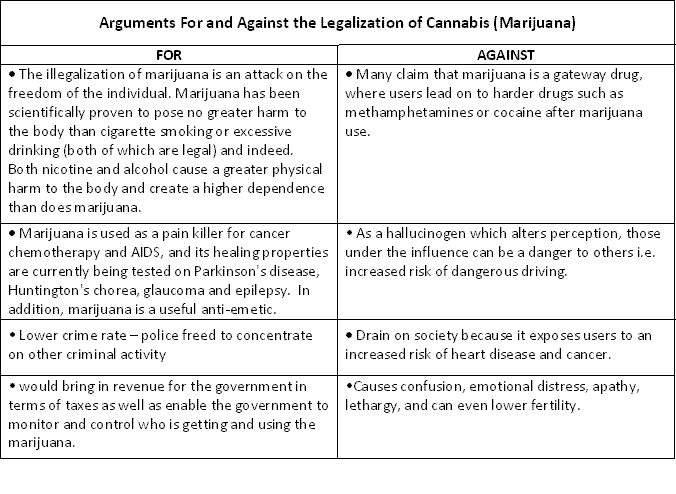
B.10.3 Discuss the arguments for and against the legalization of cannabis. Arguments for legalisation include the ability of cannabis to offer relief for certain disease. Arguments against legalization include the possible harmful effects and the possibility of cannabis users moving on to harder drugs.
B.8 Stereochemistry in Drug Action and Design
B.8.1 Describe the importance of geometrical isomerism in drug action. Students should be aware that cis- and trans-isomerism can occur in inorganic complexes and that the two different isomers can have different pharmacological effects. The anti-cancer drug cisplatin is a good example.
Geometrical Isomerism -- molecules with a carbon-carbon double bond which prevent the rotation around a bond so that the position of the atoms can change.
Cis isomer-- two functional groups will be on the same side of the double bond and bonded to two different carbon atoms.
Trans isomer-- two functional groups bonded to opposite sides of the double bond.

Physical properties of cis and trans isomers
Usually the trans isomer will have a higher melting point because the molecules are able to pack more closely together causing the forces of attaction betwen the molecules to increase. Therefore more energy needs to be absorbed in order to break them, increasing the melting point.
B.8.2 Discuss the importance of chirality in drug action. The two enantiomers in a racemic mixture of a drug may have very different effects, eg Thalidomide. One enantiomer of Thalidomide alleviates morning sickness in pregnant women, whilst the other enantiomer causes deformities in the limbs of the fetus.Chiral carbon atoms in molecules form two optically active isomers. Because of the different stereochemistry, the two enantiomers act
different in the body. Different isomers can also interact differently with disease organisms.
In synthetic drugs, both enantiomers are created, making a racemic mixture (50% of both isomers). Currently, there is no effective way to seperate the two enantiomers from each other within a sythetic drug because the two are identical is almost every way. Therefore, many drugs may posses harmful side effects. For example, Thalidomide has two enantiomers. One alleviates morning sickness while the other causes deformities in the limbs of fetuses. Unlike when thalidomide was first released, scientsits now study the effects of both enantiomers when new drugs are synthesized.
Not all racemic mixtures may have harmful effects on the body and, in some cases, one enantiomer will provide the desired pharmacological properties while the other will have no effect on the body. For example, the amino acid DOPA's L- isomer is an intermediate in dopamine biosynthesis and is given to patients to help manage Parkinson's Disease. The D-isomer has no biological effects on the body
B.8.3 Describe the use of chiral auxiliaries to form the desired enantiomer. A chiral auxillary is used to convert a non-chiral molecule into just the desired enantiomer, thus avoiding the need to separate enantiomers from a racemic mixture. It works by attaching itself to the non-chiral molecule to create the stereochemical conditions necessary to force the reaction to follow a certain path. Once the new molecule has been formed the auxiliary can be taken off (recycled) to leave the desired enantiomer. An example is the synthesis of Taxol, an anti-cancer drug.
The beta-lactam ring

Structure of Penicillin:
- 4 membered square ring with bond angles of 90o
- Ring consists of 1 N atom and 3 C atoms
- Ring is strained and so very reactive
Action:
When the beta-lactam ring comes into contact with bacteria, the ring "opens", and covalently bonds to the enzyme transpeptidase that is used to synthesize the bacterias cell wall. The enzyme's action is therefore blocked, the bacterias cell wall is weakened, and the bacterium eventually bursts
B.8.4 Explain the use of combinatorial chemistry to synthesize new drugs. Combinatorial chemistry is used to synthesize a large number of different compounds and screen them for biological activity, resulting in a 'combinatorial library' (for example the 'mix and split' process whereby polypeptides can be made by every combination of amino acids, using polystyrene resin beads). Stress the importance of solid phase chemistry.
Diamorphine (heroin) and morphine share the same basic structure, heroin is more potent and thus more addictive because of its polarity due to the presence of its functional groups.
structures of heroin and morphine
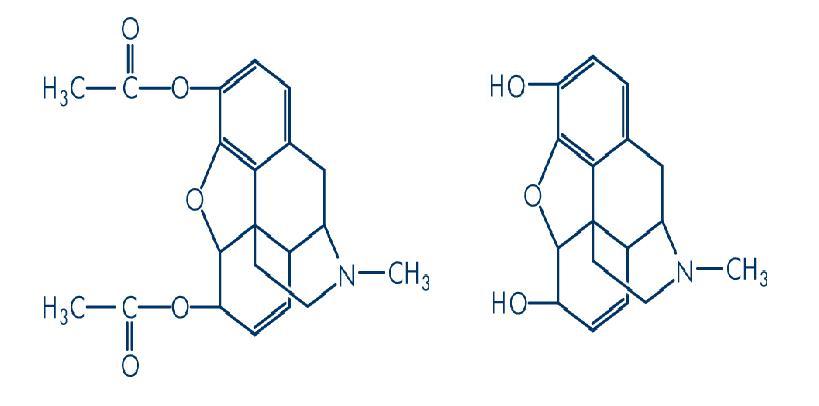 * * |
Heroin (left) - Morphine (right)
|
Structures:
- Identical except the functional groups on the left.
- Heroin has two ester groups which are less polar.
- Morphine has 2 polar hydroxyl groups
Solubility/Potency
Heroin is insoluble in water because it is less polar due to the presence of ester groups that can't form hydrogen bonds with water. Heroin can therefore be transported to the less polar/lipid parts of the body like the brain and nervous systems.Heroin will reach higher concentrations in the brain (due to is less polar nature) and thus will appear more potent and produce greater analgesic effects, which in turn, makes it more addictive. Morphine is soluble in water because the polar hydoxyl groups can form hydrogen bonds with water and will penetrate the brain less easily than heroin.
Besides defining the answers to the objective, Camille and I talked about the scene set up and the structure of the video. We clarified roles that would be played and wrote down the ideas we had for presenting the information to viewer that would be easy to understand and easy to follow. We wrote down the specific props we wanted to use and the type of reactions from an audience we wanted to create with the props and setting of our video.
Subscribe to:
Comments (Atom)